PSU partners with TCEB, Ministry of Interior, and OVEC to advance “Songkhla Model” for MICE city development
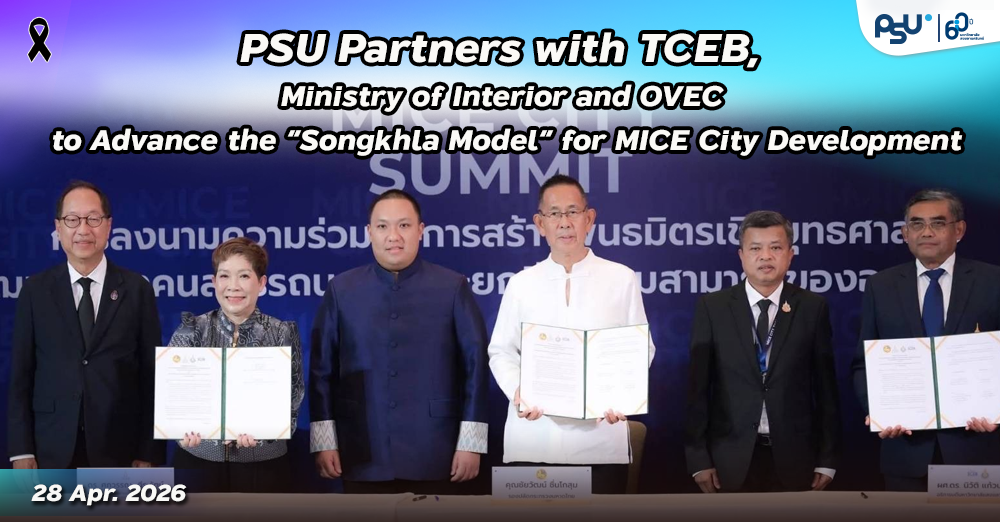
Prince of Songkla University, together with the Thailand Convention and Exhibition Bureau (TCEB), the Ministry of Interior, and the Office of the Vocational Education Commission, signed a strategic partnership agreement to develop high-competency professionals and enhance Thailand’s MICE industry, using the “Songkhla Model” as a framework for sustainable city, workforce, and local economic development.
The signing ceremony was held on April 28, 2026, in Bangkok, with representatives from all four organizations joining the agreement and distinguished guests serving as witnesses.
PSU President emphasized that the university is ready to share the success of the Songkhla Model as a regional living lab that connects higher education with city development through the MICE industry. Through the Songkhla Convention and Exhibition Bureau, or SCEB, under PSU’s supervision, Songkhla has been actively advanced toward international standards.
This success has earned Songkhla international recognition, including being ranked Thailand’s number one sustainable MICE city for three consecutive years by the GDS-Index 2025, third in Asia, and 28th globally. Songkhla was also ranked seventh globally in social progress and recognized as an IFEA World Festival & Event City 2025.
The President added that Songkhla’s success goes beyond hosting events or gaining international recognition. It has been transformed into practical knowledge for education and workforce development through a flexible credit bank system that connects learning, work, and city development.
This partnership marks an important step in advancing MICE for city development to international standards. It brings together four strategic organizations to strengthen the role of the MICE industry as a key mechanism for developing cities, people, and local economies in a systematic and sustainable way.
Under this collaboration, the Songkhla Model will be used as a prototype
for developing curricula, building high-competency professionals, and
creating a learning ecosystem that connects national policy with real
implementation in local areas. The initiative also aims to expand to
other MICE cities and high-potential cities across Thailand, helping
generate income, distribute opportunities, improve quality of life, and
position Thailand as a sustainable destination for the global MICE
industry.