PSU Researchers Turn Thai Cassava Starch into Bioplastics and Smart Packaging to Tackle Waste and Boost Food Safety
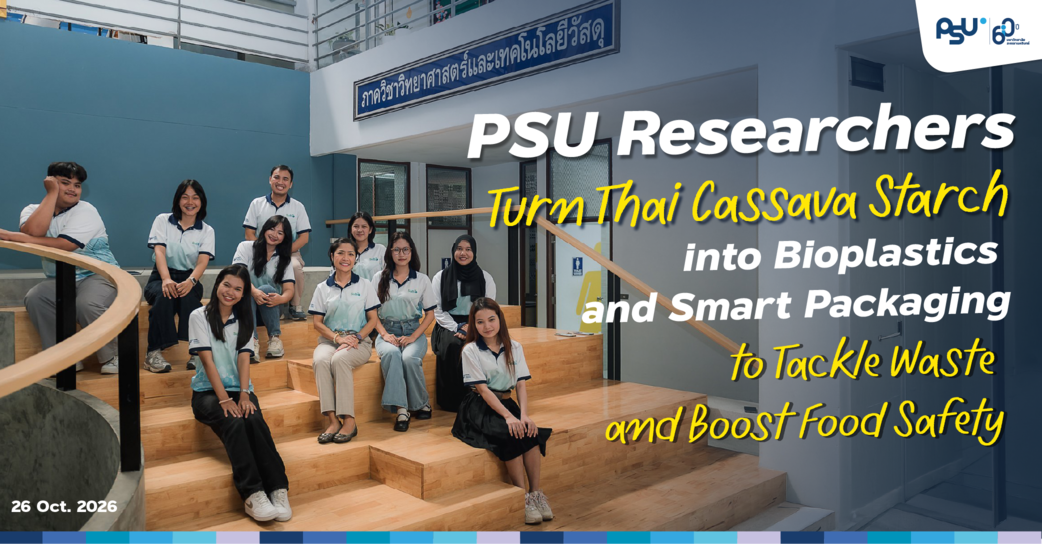
As growing environmental awareness leads younger generations to embrace the Zero-Waste concept and pay closer attention to the safety of what they consume every day, efforts to solve the plastic waste problem remain held back by cost and practical limitations. However, the latest advances from a research laboratory at the Faculty of Science, Prince of Songkla University (PSU), led by Assoc. Prof. Dr. Kaewta Kaewtatip and her team, are demonstrating that cassava, one of Thailand’s staple economic crops, can revolutionize the food chain and the environment from upstream to downstream. By synthesizing cassava into advanced bio-based materials, the team is developing Cassava Starch-Based Bioplastics and Sustainable Packaging Materials.

Assoc. Prof. Dr. Kaewta Kaewtatip explained the goal of the research: “The key challenge is not just making biodegradable plastics in the laboratory, but delivering sustainability that is truly tangible in everyday life. We started by looking at agricultural waste and cassava starch, then designed them into bio-based structures for specific purposes. These range from seedling pots made from natural fibers and cassava starch that return to the soil on their own within 28 days without leaving microplastics, to food packaging pouches and cassava starch foam trays that can fully replace synthetic foam, are safe for health, and are ready to support the growth of modern industries.”

The most notable advance addresses a key pain point close to consumers’ daily lives: food freshness and hygiene. The research team has developed an edible coating that slows fruit spoilage, along with an oil-resistance coating for paper that makes paper food boxes highly resistant to grease without relying on synthetic plastic films. Another high-tech highlight is smart packaging, which transforms consumer confidence with a bio-based indicator strip that changes color in real time according to the freshness and decomposition of seafood such as shrimp and fish, allowing consumers to check the quality of fresh food instantly with the naked eye.

Assoc. Prof. Dr. Kaewta further explained the link to the food chain: “When we talk about sustainability, it’s not something distant from people’s lives. Having a color-changing sensor that can accurately tell whether the seafood in your hand is still fresh, safe or starting to deteriorate means using science to directly reduce food waste and protect consumer health. All of this is built on the use of domestic natural raw materials, which are steadily gaining economic value.”
This move from laboratory research to real-world application not only reflects the ability of Thai researchers to develop materials science for sustainability, but also marks an important step in showing that green technology can be fully and concretely integrated with health and quality of life for everyone.