Cutting-edge Thai innovation: “Watson” evidence-detection device by PSU researchers elevates forensic science
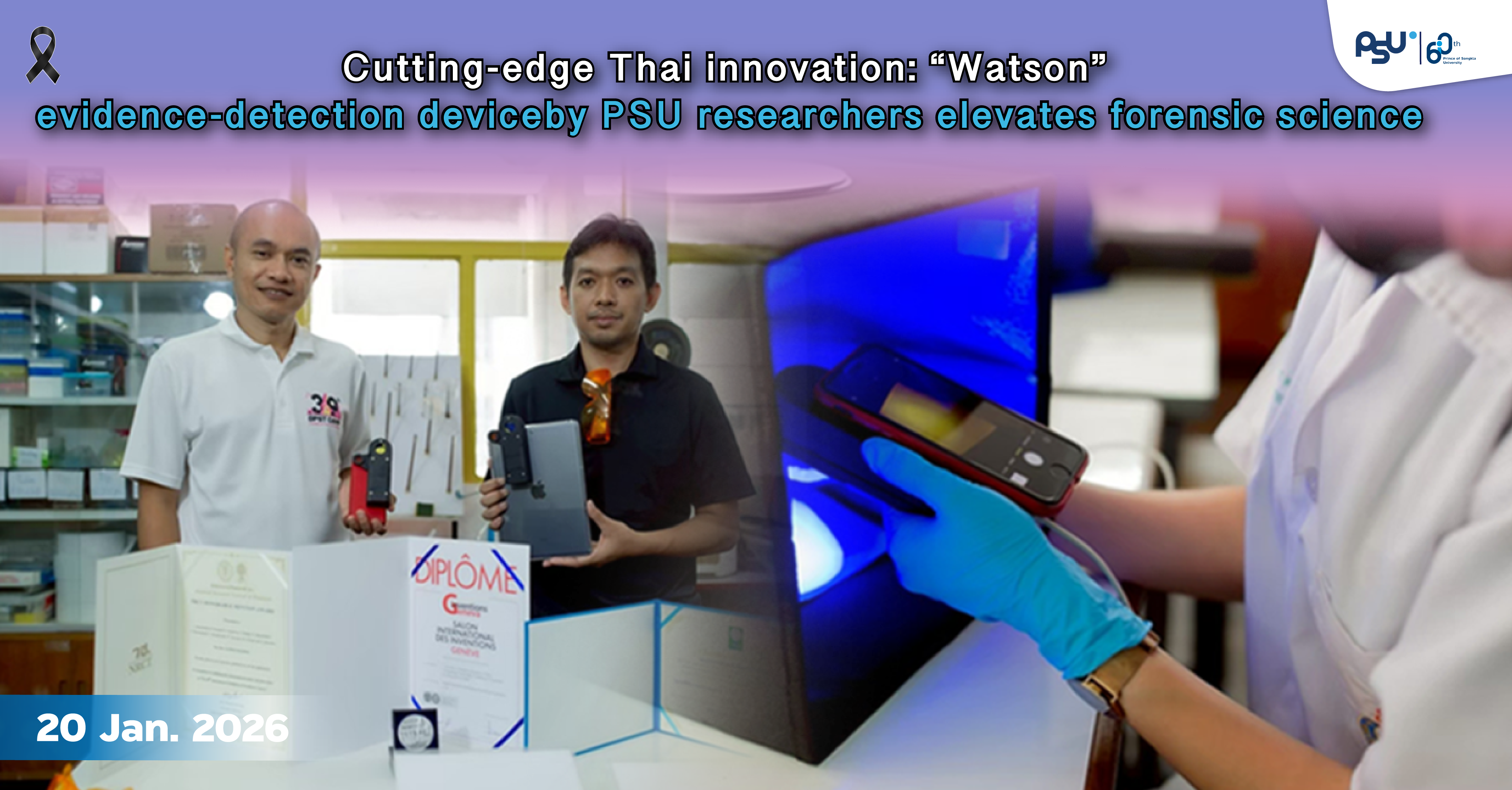
“The name ‘Watson’ comes from Dr. John Watson in the famous Sherlock Holmes detective stories. He plays a key role in helping solve cases and makes Sherlock Holmes’s work easier. In the same way, we designed this device to serve as an assistant helping forensic officers work faster and more efficiently,” the research team explained.
Advances in science and technology can help address major social problems, especially those related to serious crimes such as homicide and sexual assault. This vision has led to a Thai innovation called “Watson” a device that can detect semen stains, saliva, and other biological traces that are difficult or impossible to see with the naked eye. Designed to be used with a smartphone camera and a specialized light source for forensic evidence, Watson improves both the accuracy and speed of on-site work by forensic evidence officers. The device was created and designed by a research team from the Faculty of Science, Prince of Songkla University (PSU).


Assoc. Prof. Dr. Chittanon Buranachai, a researcher at the Center of Excellence for Trace Analysis and Biosensor, PSU, said that Watson supports both biological evidence searching and forensic photography. He emphasized that Watson’s strengths include high specificity, strong illumination, and ease of use, comparable to expensive imported equipment while remaining significantly more affordable, enabling Thai forensic police units to access advanced technology more easily.
“Watson is a biological evidence detection and forensic imaging device specifically designed for field operations. It is portable and cost-effective, yet delivers performance comparable to foreign equipment. It is ready to be expanded for real-world use across the South and potentially nationwide, strengthening Thailand’s forensic capabilities to meet international standards,” Dr. Chittanon added.
Assoc. Prof. Dr. Phuvadol Thanakiatkrai, Director of the Forensic Science Innovation and Service Center PSU, explained that the development was driven by two key challenges: (1) budget constraints faced by forensic police units and (2) operational convenience. Watson was created to make internationally standard forensic tools and services more accessible within limited government budgets, while ensuring effective use in real working conditions. The Center hopes that every service and innovation it develops will help strengthen justice for society.
“This is the outcome of more than nine years of research and development by the Faculty of Science, PSU. Watson’s core purpose is to make the justice process more thorough, clearer, and faster. It is also designed to be widely accessible and delivers performance comparable to foreign tools, helping elevate Thai forensic science to international standards,” Dr. Phuvadol said.
Dr. Kittirat Phooplub, a researcher at the Center of Excellence for Trace Analysis and Biosensor, PSU, added that Watson has been continuously refined over the past nine years to maximize usability. The latest version is compact, easy to carry, and compatible with smartphone cameras. Field testing has produced strong feedback, with evidence detection results closely comparable to standard equipment used by forensic centers.
“‘Watson’ is a source of pride for Thailand as an innovation that can help solve real social problems. It has been granted petty patent protection for both invention and design. It previously received a ‘Very Good’ level award from the National Research Council of Thailand, and won a silver medal in Geneva, Switzerland, confirming its high value and public benefit. We are confident that in the future, Watson can be further developed and upgraded to meet industrial standards,” Dr. Kittirat concluded.